In this guide
Answering the question, the best 300 gallon canister filters balance high flow, reliable filtration, and easy maintenance for large tanks. This guide highlights five strong choices that are well-suited for aquariums around 300 gallons, with notes on who benefits most from each model. Whether you’re building a community reef, a planted freshwater display, or a turtle tank, these filters help keep water clear and stable.
| Product | Best For | Why It Stands Out |
|---|---|---|
| Fluval FX6 | Very large tanks or heavy bioload | High flow, comprehensive filtration, built-in water changes |
| Fluval FX2 | Large freshwater setups and communities | Strong multi-stage filtration with smart pump tech |
| Fluval FX4 | Versatile mid-to-large systems | Robust media capacity; good for mixed species tanks |
| fishkeeper 390GPH | Budget-friendly, smaller-large tanks | Quiet operation with adjustable flow |
| OASE BioMaster 2 Thermo 250 | Quiet, integrated heater solution | 4-stage filtration and built-in heater for easy setup |
Fluval FX2 High Performance Canister Filter
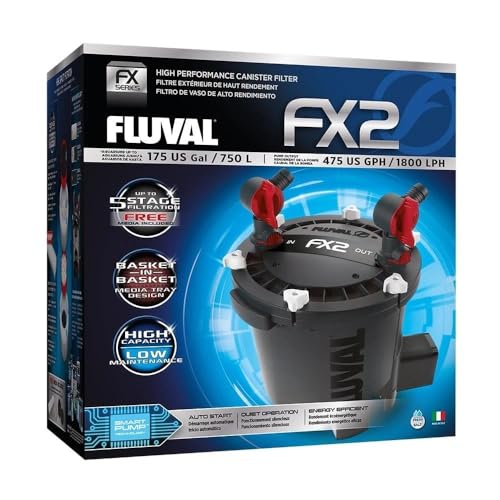
The Fluval FX2 offers multi-stage filtration with a high-performance pump rated for 475 US gallons per hour. It includes a Smart Pump microchip that continually monitors and optimizes pump performance, and a self-starting design that activates automatically once water is added. A base drain supports seamless water changes, and lid-mounted clips keep hoses neatly stored. Best for large community tanks or heavy filtration needs, the FX2 provides strong all-around filtration with convenient maintenance features. A potential limitation is its size and higher upfront cost, which may be a consideration for smaller stands or tighter spaces.
Best for: Large freshwater tanks with a heavy bioload or complex filtration needs. It’s a solid match for aquariums approaching the 300-gallon range where reliable, high-capacity filtration is required.
VEVOR Aquarium Filter 528GPH, 5-Stage Canister Filter

The VEVOR 5-Stage Canister Filter delivers up to 660 GPH (2500 L/H) with a compact footprint, and is designed for tanks around 235 gallons or similar setups. It features a UV protection option, a quiet copper brushless motor, and a dual quick-release head for easy maintenance. Customers should consider that flow rates can drop under load and with height differences, so fine-tuning may be needed for optimal performance. It’s best for mid-to-large tanks where budget-conscious options are valued without sacrificing filtration stages.
Best for: Large tanks needing strong filtration without the premium price tag of higher-capacity models. Good for users who value quiet operation and straightforward maintenance.
PONDFORSE Canister Filter

The PondForse canister filter uses multiple filtration media layers to remove particles and impurities, delivering crystal-clear water and a stable ecosystem. It offers an adjustable flow rate to fit various tank sizes and types, and emphasizes energy-efficient, steady performance. Its main limitation is that third-party measurements of real-world flow may vary with height and setup, so planning a taller stand or longer intake/exit tubes might affect flow. Choose this if you want a versatile, mid-range option with solid filtration capacity.
Best for: Large aquariums where an adjustable, multi-media filtration approach is desired without premium features or heaters. Suitable for hobbyists who want flexible flow control.
Fluval FX6 High Performance Canister Filter
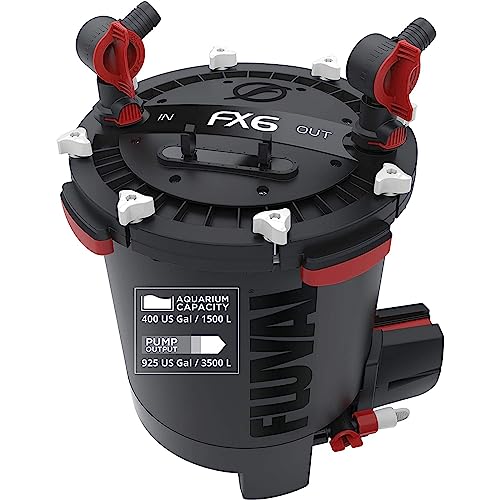
The Fluval FX6 is designed for aquariums up to 400 gallons, delivering about 925 US gallons per hour. It uses Smart Pump microchip technology for continuous performance optimization and features self-starting operation with automatic air evacuation every 12 hours. It also supports easy water changes by attaching hoses to the output, reducing heavy lifting. The FX6 is a powerhouse for large, heavily stocked tanks but can be overkill for smaller setups or tight spaces.
Best for: Very large tanks or setups with substantial filtration demands that require top-tier flow and water-change convenience. Consider this model when maximum capacity is a priority.
fishkeeper 390GPH Canister Filter
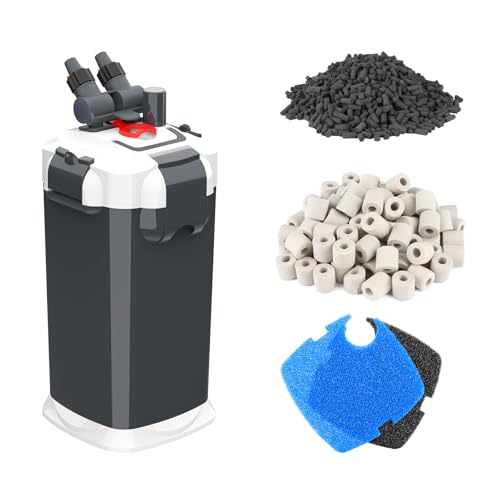
The fishkeeper 390GPH Canister Filter provides 390 GPH, with a three-stage filtration approach and quiet operation via a copper brushless motor. It features adjustable flow to fit different tank sizes and types, delivering robust water circulation for mid-to-large tanks. A practical limitation is that it may not reach the highest flow numbers of premium models, so users with very heavy bioloads should consider higher-capacity options. It’s a cost-effective choice for sizable setups that don’t require top-tier flow.
Best for: Budget-conscious aquarists with mid-to-large tanks who still want reliable filtration and adjustable flow. A practical pick for growing or moderately stocked tanks in the 200–300 gallon range.
Buying Guide
What to consider when choosing a 300 gallon canister filter
Look for high flow that matches your tank’s turnover needs. A filter around 4–7 times the tank volume per hour is common for heavy bioloads in large tanks. Consider multi-stage filtration (mechanical, chemical, biological) and media capacity to manage organics and nitrates effectively.
Filtration stages and media compatibility
Filters that accept a variety of media (sponges, bio-balls, activated carbon, ceramic rings) provide flexibility. Large tanks benefit from bigger media baskets to reduce bypass and maintain stable water quality. Check if the unit includes or allows easy addition of bio-media for robust biological filtration.
Maintenance and ease of use
Features like auto air vent, integrated water-change capabilities, quick-release clamps, and easy drain valves save time. Consider pump reliability, electrical consumption, and noise level if the tank is in a living space or office.
Electrical efficiency and noise
Quiet operation and energy-efficient motors are important for long-term use. Brushless DC motors and smart sensors help keep running costs and noise to a minimum, which matters for rooms with sensitive occupants or pets.
Space, fit, and installation
Ensure the canister footprint fits your stand or cabinetry. Taller canisters may require longer intake and output tubing. Some models offer built-in heaters or integrated features, which can streamline installation in tight spaces.
Which model should you choose?
- For maximum capacity and water-change convenience in a very large, high-load tank, consider the Fluval FX6.
- For a balance of size, performance, and smart pumping, the Fluval FX2 remains a strong general-purpose option.
- For versatile filtration with solid media capacity and mid-to-large tanks, the Fluval FX4 is a dependable pick.
- If budget is a priority and you need a quieter, adjustable-flow option for a large tank, the fishkeeper 390GPH is practical.
- If you want a built-in heater in the same unit for streamlined setup, the OASE BioMaster 2 Thermo is a compelling choice.
Maintenance quick reference
- Inspect media monthly and rinse or replace as needed.
- Check seals, hoses, and clamps to prevent leaks.
- Test water flow and adjust as bioload changes.
- Plan regular partial water changes in tandem with your filter schedule.
Short FAQ
- Which filter is best for a 300-gallon reef tank? Models with high flow and sturdy media capacity, such as the Fluval FX6, are well-suited for reef setups that require robust filtration and reliable performance.
- Do canister filters use a lot of energy? Energy use varies by model, but several options feature efficient motors and smart controls to reduce power consumption during operation.
- Is a heater included in canister filters? Some models offer built-in heaters or heater-ready configurations; others require separate heating equipment depending on the setup.
- How often should I service a 300-gallon canister filter? Regular maintenance every 4–6 weeks is common, with media cleaning or replacement scheduled based on bioload and water quality.
- Can I use multiple filters on one tank? Yes, but ensure proper sizing and avoid excessive backpressure. Proper circulation and compatibility with tank inhabitants are essential.
- What if my filter is too noisy? Check for air pockets, loose fittings, and improper mounting. A quiet motor or vibration dampening can reduce noise significantly.